
#Q240. 「一本通 6.6 练习 9」网格
-
ID: 2322
Type: Default
1000ms
512MiB
Tried: 0
Accepted: 0
Difficulty: (None)
Uploaded By:
 chengweisun
Tags>
chengweisun
Tags> 「一本通 6.6 练习 9」网格
Description
Original source: BZOJ 3907
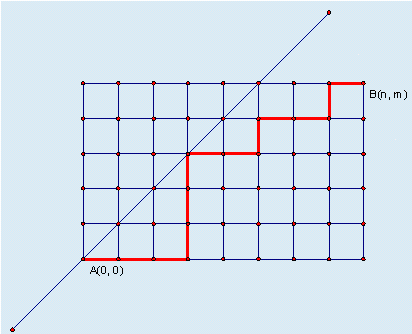
The streets of a certain city form a grid, with the bottom-left corner at coordinate and the top-right corner at coordinate , where . Starting from point , you can only move along the streets to the right or upwards. Additionally, you cannot pass through any point above the diagonal line shown in the figure, meaning any point on the path must satisfy . Under these constraints, how many distinct paths are there to reach ?
Input Format
The input consists of a single line containing two integers and , representing the dimensions of the city grid.
Output Format
Output a single integer followed by a line break or carriage return, indicating the total number of distinct paths.
Sample 1
6 6
132
Constraints & Notes
For all test cases, .